
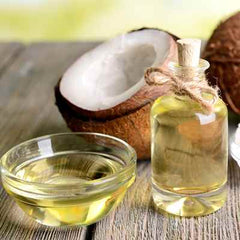
Organic Fractionated Coconut Oil
Lightweight Nourishment. Soft, Smooth Finish.
Fractionated coconut oil isn't a different kind of coconut oil—it's simply the liquid portion of coconut oil that has been mechanically separated from the portion that naturally solidifies at cool temperatures.
Coconut oil is made up of several different fatty acids, each with its own melting point. Some remain liquid at cooler temperatures, while others naturally become solid as they cool.
Our organic fractionated coconut oil is created by separating these naturally occurring "fractions" out of organic coconut oil, leaving behind a lightweight, clear oil that remains liquid even in cooler temperatures.
How Coconut Oil Is Fractionated
The word fractionated may sound complicated, but the process is actually quite simple. It doesn't involve changing the oil, creating something new, or using chemicals. Instead, it separates the naturally occurring components of coconut oil based on their melting points.
- Since our fractionated coconut oil is organic, the process begins with cold-pressed organic coconut oil.
- It is gently warmed until it becomes completely liquid.
- Then it is cooled slowly.
- As the temperature drops, the longer-chain fatty acids solidify first because they have a higher melting point.
- The solid fatty acids are filtered off and separated from the remaining liquid oil.
- What is left behind is a lightweight oil that stays clear and liquid at room temperature.
Fractionated coconut oil is a lightweight emollient that glides easily over the skin and absorbs quickly, leaving a soft, silky feel without the heaviness of traditional coconut oil. Its stability, long shelf life, and elegant skin feel make it a popular choice for massage oils, facial oils, lightweight moisturizers, hair serums, and other leave-on products.
So, if both begin as coconut oil, why do virgin coconut oil and fractionated coconut oil look and behave so differently? The answer lies in what remains after the fractionation process.
Organic Fractionated Coconut Oil vs. Virgin Coconut Oil
Although they are both types of organic coconut oil, they have very different properties and are used for different purposes.
Virgin coconut oil is the whole oil, containing the full range of naturally occurring fatty acids along with many of the minor compounds that contribute to its characteristic coconut aroma, rich texture, and solid consistency at cooler temperatures.
Fractionated coconut oil contains only the liquid portion of coconut oil. It is clear, lightweight, virtually odorless, and remains liquid at room temperature. Its silky texture and quick absorption make it ideal for lightweight skin and hair care products.
Neither oil is "better" than the other—they simply have different strengths.
We often choose virgin coconut oil when we want the richness and natural character of whole coconut oil. We choose fractionated coconut oil when we want a lightweight, silky oil that spreads easily, absorbs quickly, and remains liquid year-round.
Is Fractionated Coconut Oil the Same as MCT Oil?
Although fractionated coconut oil is often marketed as MCT oil, the two terms are not exactly the same. They are closely related and are sometimes used interchangeably, but they describe different things.
First...what are MCTs?
MCT stands for Medium-Chain Triglycerides.
A triglyceride is a molecule made of three fatty acids attached to a glycerol backbone. These fatty acids vary in length. Some are short, some are long, and others, like the ones we are talking about, are medium chain.
Medium-chain fatty acids are named for the number of carbon atoms they contain. For example:
- Caproic acid has 6 carbon atoms (C6)
- Caprylic acid has 8 (C8)
- Capric acid has 10 (C10)
- Lauric acid has 12 (C12)
The “C” just refers to carbon atoms. So when we talk about medium-chain triglycerides, we’re referring to triglycerides built from fatty acids that are between 6 and 12 carbon atoms long.
Since Fractionated coconut oil is made up primarily of the naturally occurring medium-chain triglycerides caprylic (C8) and capric (C10), it is often referred to as MCT oil.
But the term MCT oil is a broad category that describes a type of fat rather than a specific ingredient.
While fractionated coconut oil must come from coconut, depending on the manufacturer, MCT oils may be derived from coconut oil, palm kernel oil, or a combination of both, and they can vary in their fatty acid composition, extraction process, and intended use.
Why We Choose Fractionated Coconut Oil
Our fractionated coconut oil, made from organic coconut oil, has a silky feel and glides easily over the skin and hair without the heaviness of virgin coconut oil. Because it remains liquid year-round and has a silky, lightweight feel, it is ideal for:
- Leave-in hair conditioners
- Scalp massage oils
- Frizz-taming serums
- Massage oils
- Lightweight facial and body oils
Virgin coconut oil and fractionated coconut oil each have their place. Rather than asking which one is better, we ask which one is better suited for the product we're creating.