Bamboo Charcoal in Natural Skin Care
What is Bamboo Charcoal?
Bamboo charcoal is made up of pieces of the rapidly growing Moso bamboo, Phyllostachys edulis, plant. As the Moso bamboo matures, millions of tiny holes or pores form in the stalks.
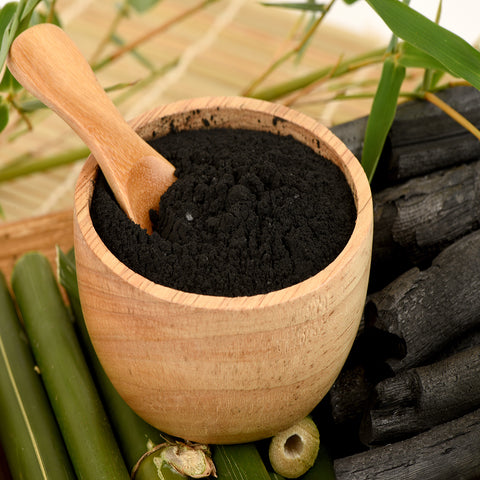 These tiny holes increase the surface area of the bamboo. As a result, a single gram (.035 ounces) of bamboo charcoal has as much as 600 square meters (718 square yards) of surface area.
When the bamboo reaches the age of five, it is harvested and cut into pieces. These pieces undergo a firing process at temperatures of 1800 degrees Fahrenheit to create the bamboo charcoal.
What Is Activated Bamboo Charcoal?
To “activate” bamboo charcoal, it is ground into a powder and injected with steam (no other chemicals). This “activation” process increases the surface area twofold. This large increase in surface area is what gives activated charcoal its beneficial properties.
The more surface area available, the faster the rate of adsorption.
This means that the powder can adsorb (yes, the word is adsorb) a greater volume of bacteria, impurities, and micro-particles. While regular bamboo charcoal and activated charcoal have the same adsorption abilities, activated carbon has a tighter hold on the substances it adsorbs.
Adsorption vs Absorption
When reading about charcoal, you will often see the word "adsorption." This is not a typing error. There is a difference between adsorption and absorption.
 Adsorption is a process in which impurities or chemicals attach or adhere to the surface of a material.
You can think of a material that adsorbs, like charcoal, acting as a magnet to draw impurities to its surface.
This should not be confused with the word absorption, in which the impurities or chemicals would actually pass into and become part of the material--like a sponge absorbs water.
Adsorption only involves the surface of the material, while absorption involves the whole volume of the material.
For example, when you cut yourself, you may apply a salve to your cut, and the salve will be absorbed into your skin. When you cover the cut with an adhesive bandage, the bandage adheres to the surface of your skin. Activated charcoal adsorbs impurities, it does not absorb them.
History of Activated Charcoal
While the addition of activated charcoal to personal care products may seem new, charcoal has been used for medicinal purposes for thousands of years. The first recorded use of medicinal charcoal comes from an Egyptian medical papyrus written around 1500 BCE, when ancient Egyptians used charcoal to adsorb wound odor.
Today charcoal is still used to purify the water we drink. It is used in air filters to purify the air we breathe and in the ground to detoxify the soil in which we grow our food. Medicinal charcoal is used in the treatment of drug overdose and poisoning, in kidney and liver dialysis machines, and in wound dressings. It is also an effective, natural deodorizer. It was mixed with water and taken internally for poisoning, indigestion, and diarrhea, or used externally in poultices, compresses, or baths to help treat infections, pain, and remove impurities from the skin.
Why Bamboo?
Bamboo is widely valued as a sustainable resource because it grows rapidly and regenerates naturally when harvested responsibly—without the need for synthetic fertilizers, herbicides, or pesticides. The bamboo used for charcoal is typically Moso bamboo, which grows at lower elevations and is not part of the natural mountain habitat of giant pandas. Using bamboo charcoal does not take food away from pandas and supports responsible, renewable sourcing.
While activated wood charcoal has similar properties, activated bamboo charcoal is four times more porous than regular wood charcoal, which greatly increases its effectiveness to eliminate impurities and neutralize odors.
The other consideration is that wood charcoal comes from “mixed woods.” Since we do not know the composition of mixed wood charcoal, it could pose a problem for folks with allergies or sensitivities. We also cannot answer other questions like, "Where did the wood come from?" "Was it harvested sustainably?" or "Was it sprayed with pesticides?"
Bamboo charcoal is an environmentally friendly and ecologically responsible ingredient. It is 100% natural and safe to use around pets and children.
How Bamboo Charcoal Works In Skin Care
Although the internet is jam-packed with loads of information about the benefits of activated charcoal, there have been no scientific studies conducted concerning the efficacy of activated charcoal in skincare.
 As with much of the information written about skincare, the evidence is anecdotal.
Anecdotal evidence comes from actual life experiences and is not regarded as scientific evidence. However, so much of what we have learned in our history began as anecdotal evidence.
Keeping this in mind, below are some of the properties of charcoal in skin care.
Because of its natural ability to draw out dirt and debris from deep inside pores, activated bamboo charcoal has become a key ingredient in many skincare products. Activated charcoal:
- adsorbs impurities due to its super-porous structure--one teaspoon has the surface area of a football field
- has millions of pores to trap and store pollutants, impurities, and other harmful substances so they can be washed away
- naturally deep cleans and gently exfoliates to remove dead skin cells without drying skin
- works especially well to deep clean oily, combination, and blemish-prone skin types
- can help ease acne; depending on the severity and type of acne, activated charcoal may offer some relief
- when used in a face mask, activated charcoal helps remove the oil and dirt from pores that make them appear larger--so pores will appear smaller.
Conclusion
Due to its natural ability to draw out dirt and debris from deep inside pores, activated bamboo charcoal has become a key ingredient in many skincare products.
Bamboo is one of the most sustainable resources available. When harvested responsibly, bamboo can renew itself for generations without synthetic fertilizers, herbicides or pesticides.

Creating A Facial Skin Care Routine
Clay Facial Mask Recipes & The Science Behind Them
What Is A Facial Cleansing Oil? How Do I Use It?