Why Talk About the Skin Barrier?
The phrase “supporting the skin barrier” shows up everywhere in skin care today — but it’s rarely explained in a way that actually helps people understand what’s happening on their skin.
As someone who formulates organic, water-free, plant-based facial and body products, I think it’s important to slow down and talk about what the skin barrier really is, why it matters, and how natural plant-based oils and creams genuinely support it.
This isn’t about trends. It’s about skin biology.
What Is the Skin Barrier?
Before zooming in on the skin barrier, it helps to understand how our skin is structured.
 Skin is the protective covering that surrounds the entire body, shielding us from the outside world. It has three primary layers:
- Epidermis — the thin, outermost layer we see and touch
- Dermis — the thicker middle layer containing blood vessels, nerves, follicles, and glands
- Hypodermis (Subcutaneous Layer) — the deeper fatty layer that cushions and insulates the body
Each layer has sublayers with specialized functions, but when we talk about skin care, our focus is on the outermost part of the epidermis, called the stratum corneum.
This is what we commonly call the skin barrier, because it regulates what leaves the skin and what stays inside.
The structure is often described as a brick-and-mortar wall:
- Dead skin cells (corneocytes) act as the bricks
- Lipids — ceramides, cholesterol, and fatty acids — form the mortar holding everything together
In skin biology, oils and fats are known as lipids. Although the skin cells create the framework, most of the protective work is done by the surrounding lipids, which is why this outer layer is often referred to as the lipid barrier.
When this structure is intact, skin feels soft, hydrated, resilient, and less reactive.

To understand why this matters, we need to look at how skin loses moisture.
What Is TEWL—and Why Does It Matter?
TEWL stands for transepidermal water loss, the natural process by which water moves from deeper skin layers to the surface and evaporates into the air.
 This process is normal and continuous.
Healthy skin allows water to escape slowly while still maintaining hydration and protection.
While the water is always moving upward toward the stratum corneum, this outer skin layer acts like a protective lid. Its tightly packed cells and lipid structure slow evaporation.
But when the lipid “cement” between skin cells begins to erode or develop cracks, the brick structure becomes less stable. Tiny gaps form, transepidermal water loss (TEWL) increases, and water evaporates faster than skin can replace it — even though plenty of water still exists deeper in the skin.
The result is skin that feels dry or tight, rough or flaky, easily irritated, and less supple
This relationship between water rising from below and lipids controlling its escape is the foundation of barrier function.
Strengthening the skin barrier is one of the most effective ways to help reduce excessive TEWL.
Where Does Skin Moisture Come From?
If moisture constantly evaporates from the skin, where does that water come from?
The water reaching the skin begins with what we drink and eat. After absorption into the bloodstream, it travels throughout the body, including the skin.
 The dermis, the deeper living layer of skin, contains blood vessels that continually supply it with water and nutrients.
You can think of it as a moisture reservoir.
But the epidermis has no blood vessels. So how does water reach the surface of the skin?
Imagine placing a wet sponge on a counter — this represents the dermis. Now lay a dry paper towel on top — this is the epidermis.
Even without pouring water on the towel, it becomes damp. Water naturally moves from wetter areas to drier ones.
Skin behaves in a similar manner. Water moves upward and eventually evaporates from the surface.
When the barrier is healthy, this happens slowly. When weakened, water escapes too quickly, leaving skin dry and uncomfortable.
What Increases Transepidermal Water Loss?
While some degree of water loss is normal, TEWL increases when the skin barrier is weakened or when the environment promotes evaporation. Several factors can contribute:
- Low humidity and dry indoor air
- Cold weather and wind
- Over-cleansing or over-exfoliating
- Harsh detergents and surfactants
- Sun exposure
- Aging
- Genetic differences in barrier strength
Often, several factors overlap, making skin suddenly feel dry or reactive even when routines haven't changed.
Why Lipids Matter More Than Water for Barrier Support
Have you ever stepped out of a warm shower and noticed how your skin looks smoother, softer, almost glowing?
That fresh look isn’t your imagination. Warm water increases circulation, softens dead skin cells, and temporarily plumps the outer skin layer. This is true hydration, but the effect is short-lived.
Think of soaking a wrinkled raisin in warm water. It plumps up, but once removed, it will shrivel again as moisture evaporates.
 But wrap that raisin in plastic, and it stays soft and plump longer because evaporation slows.
Our skin behaves in much the same way. Plant oils and oil‑based creams don’t add water; instead, they slow the loss of the moisture that’s already there, helping skin stay comfortable longer.
This helps explain why hydration and barrier support are related, but not the same thing.
The term moisturizer can be misleading. In everyday language, moisturizing means adding water, yet many products labeled as moisturizers contain little or no water at all.
Furthermore, if water is applied to the skin without enough surface lipids, it quickly evaporates, leaving the skin feeling dry and tight again.
Lipid-rich natural oils and butters work differently, which helps explain why water-free formulations can provide sustained skin comfort — even though they don’t “moisturize” in the traditional sense.
They strengthen the barrier, allowing skin to retain its own moisture instead of losing it too quickly.
Oil-based skincare works best when applied to clean, slightly damp skin — especially after a warm bath or shower, when the skin is softened, and a small amount of water still remains on the surface.
Applying oils at this moment helps trap that moisture, lock it in, and slow evaporation.
That’s why oils can feel so deeply comforting when used this way — they reinforce the skin barrier at exactly the right moment.
How Plant Oils Strengthen Barrier Function
Healthy skin relies on a balance of lipids — ceramides, cholesterol, and fatty acids — that hold cells together.
When this lipid structure weakens, moisture escapes, and skin becomes irritated.
So where do plant oils fit in?
While plants don’t produce cholesterol, they generate phytosterols, which have a structure similar to human cholesterol. These phytosterols seamlessly integrate into the natural lipid barrier, helping to repair and reinforce it.
Many plant oils are also rich in linoleic acid, the most abundant polyunsaturated fatty acid in skin and essential for barrier integrity.
Plants also produce phytoceramides that closely mirror the structure of ceramides naturally produced in human skin and help reinforce the lipid cement structure of the barrier.
Healthy skin is never built from a single ingredient. The barrier works as part of a complex living system. This is why simply applying a single isolated ingredient — even something as viral as ceramides — rarely helps repair a weakened barrier on its own.
Instead of trying to recreate the skin barrier in a lab, we prefer to work with nature’s chemistry. Unrefined, cold-pressed plant oils contain a spectrum of fatty acids, phytosterols, phytoceramides, antioxidants, and other naturally occurring compounds that work in tandem with the skin.
Barrier support isn’t about replacing one missing ingredient — it’s about supplying compatible lipids that help skin maintain its own system.
Why Oil-Based Skincare Works So Well
Understanding what plant oils contain is only part of the story. The next question is what happens when they’re applied.
This is where oil-based skincare — both oils and oil-based creams — really shines.
Unlike water-based lotions, oil-based formulations focus on natural oils and butters that complement the skin’s lipid structure. They form a breathable protective layer that slows moisture loss while delivering compatible lipids.
 Because oils are lipid-soluble, they interact naturally with skin without relying on emulsifiers or preservatives.
Unrefined plant oils deliver beneficial nutrients directly to the skin, including antioxidants and essential fatty acids that help defend against environmental stress and encourage the skin’s natural repair processes. Many oils also help calm redness and irritation when the barrier is stressed.
Different oils and butters each bring their own strengths to a formulation. Here are just a few examples:
- Jojoba oil is not a true oil but a liquid wax composed of up to 98% long-chain wax esters that effectively act as a ceramide-like substance to seal in moisture and repair the skin barrier.
- Oils like sunflower and grapeseed are natural sources of phytoceramides, the plant-based ceramides.
- Grapeseed, sunflower, rosehip, argan, and pumpkin oils supply linoleic acid — an essential fatty acid needed to help maintain a strong, resilient skin barrier and reduce the dryness that comes with moisture loss.
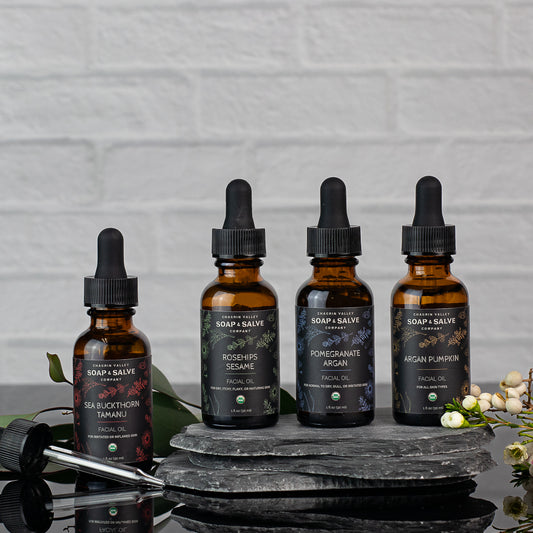
- Sea buckthorn oil is uniquely rich in Omega-7 (palmitoleic acid), a rare and vital nutrient that helps maintain, replenish, and repair the skin barrier. Known as the “beauty omega,” this oil is one of the most potent botanical sources of this powerful compound.
- Olive-derived squalane mirrors components of the skin’s natural oils, helping it absorb smoothly and enhance softness and barrier comfort without feeling heavy.
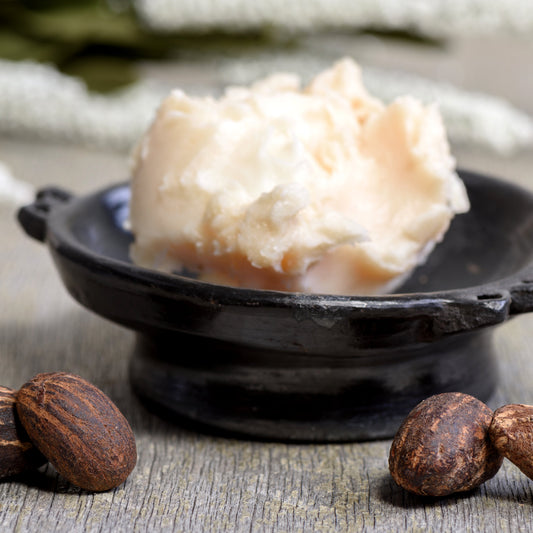
- Sea buckthorn oil and shea butter contribute phytosterols and fatty acids that help reinforce the skin’s lipid structure while providing lasting protection against moisture loss and environmental stress.
By reinforcing, replenishing, and protecting the skin’s lipid structure, natural oil-based skincare helps fortify the barrier, improve resilience, and promote lasting comfort.
Why We Choose Water-Free, Oil-Based Skincare
Most lotions contain 60–80% water. While water feels refreshing, it doesn’t strengthen the skin barrier on its own. Without enough surface lipids, the water evaporates quickly, often leaving skin feeling dry again soon after application.
Oil-based creams and facial oils work differently. When applied, they spread across the surface and form a breathable protective film that helps reinforce the skin’s outer lipid layer.
By eliminating water, these formulations are more concentrated and nutrient-dense, focusing entirely on nourishing plant oils and butters that fortify barrier integrity and help maintain balanced, comfortable skin. And since they contain no water, they do not require preservatives to prevent microbial growth.
This approach isn’t about what feels lightest immediately — it’s about what supports skin over time.
Bringing It All Together
Healthy skin ultimately depends on a strong, resilient barrier. When lipids are depleted, moisture escapes more easily, and skin can begin to feel dry, tight, or easily irritated.
Plant oils and butters — rich in essential fatty acids, phytosterols, phytoceramides, antioxidants, and other naturally occurring lipids — help reinforce this delicate barrier. Rather than relying on isolated or lab-engineered ingredients, they provide a spectrum of compatible compounds that work in harmony with the skin’s own lipid matrix.
When the barrier is strong, the skin is better able to hold onto its own moisture, maintain comfort, and remain soft and resilient over time — which is why thoughtfully formulated, plant-based oils and creams can make such a meaningful difference in everyday skin health.
And when the skin barrier is supported, skin simply doesn’t have to fight as hard — and it shows.