Understanding Your Hair
Begins with Understanding Nature
For many of us, getting to know our hair feels like a lifelong puzzle. One day our hair is soft and shiny, the next it’s dry or frizzy — and no amount of products seems to work for long. The truth is, your hair isn’t being difficult. It’s simply being itself.

Every head of hair is as individual as a fingerprint, shaped by a unique combination of type, texture, density, and porosity. Once you understand how your hair naturally behaves, caring for it becomes much easier — and far more rewarding.
At Chagrin Valley Soap & Salve, we believe the best way to care for your hair is to honor its natural biology and lean into the simplicity of nature — using ingredients that come from the earth, not a lab.
With gentle, plant-based formulas, you can support your hair’s true strength and beauty without harsh chemicals or synthetic shortcuts.
It is important to remember that there are no “good” or “bad” hair types.
📘 Learn More: For information on choosing products for dry, oily, or fine hair, visit our Product Knowledge Base.
Understanding Your Hair: More Than Just “Type”
When people talk about hair, they often jump straight to type — straight, wavy, curly, or coily. But your hair’s unique personality is shaped by more than curl pattern alone. The way your hair looks, feels, and responds to products depends on a combination of factors:
- Type — the shape or pattern of your strands
- Texture — how thick or fine each strand is
- Density — how much hair you actually have on your head
- Porosity — how easily your hair absorbs and retains moisture
They help you choose the right shampoo and conditioning products, understand how much moisture your hair craves, and explain why a product that works beautifully for someone else may fall flat for you
Why It Matters
Hair care is not one size fits all. Two people may both have curly hair, yet one has fine, low-density strands that get weighed down easily, while the other has coarse, high-density curls that need richer moisture to stay soft and defined.
When you know your hair’s type, texture, density, and porosity, you can finally treat it like the unique material it is — not just “curly,” “straight,” or “frizzy.”
Now let’s look at the first piece of the puzzle — your hair type.
Hair Type: Your Hair’s Natural Shape and Pattern
Your hair type is determined by the shape of your hair follicle — the tiny, tube-like structure that surrounds the root beneath the skin.

The shape of the follicle influences how your hair grows:
- Round follicles create straight hair because the strand grows evenly from all sides.
- Slightly oval follicles produce wavy hair.
- More oval or flattened follicles form curly hair.
- Very flat or ribbon-shaped follicles result in coily or kinky hair, where strands grow in tight spirals or zigzags.
The curl pattern that grows naturally from your scalp — not what happens after styling — defines your hair type. This pattern fits into four main categories, each with three subtypes, creating a total of 12 possible types.
Type 1: Straight Hair
Straight hair grows from round follicles, allowing natural scalp oils to travel easily down the strand. This often makes straight hair shiny — and sometimes oily more quickly.
Straight hair lies flat, has no curl pattern, and can vary in thickness:
- 1A: Very straight and fine
- 1B: Straight with a bit more body and volume
- 1C: Straight but thick and coarse
🍃 Care Tip: Choose lightweight formulas that cleanse without heaviness. Avoid heavy oils or butters; overwashing can trigger excess oil production.
📘 Learn More: Help Me Choose Products For Oily Hair
📘 Learn More: How To Use a Natural Dry Shampoo Powder

Type 2: Wavy Hair
Wavy hair comes from slightly oval follicles, creating gentle “S” shapes. It’s usually thicker than straight hair and ranges from loose waves to more defined, frizz-prone patterns.
- 2A: Fine and soft waves, easy to style
- 2B: Medium texture with defined waves and some frizz
-
2C: Thick, coarse waves, more resistant to styling and prone to frizz
🍃 Care Tip: Wavy hair thrives on a balance of hydration and lightness — too much moisture can weigh it down, while too little leaves it dry and dull.
Type 3: Curly Hair
Curly hair forms springy curls that stretch when wet and bounce back as they dry. Because natural oils struggle to travel down the curl pattern, curly hair tends to be drier.
- 3A: Large, defined curls with some shine
- 3B: Tighter curls, often mixed textures
- 3C: Tight, corkscrew curls with volume and definition
🍃 Care Tip: Curls crave moisture. Use nutrient-rich shampoo bars and emollient balms or oils to lock in hydration and maintain bounce.
Type 4: Coily or Kinky Hair
Coily hair grows from very flat follicles, creating tight spirals or zigzags. Though it may look coarse, each strand is often fine and delicate. The tight pattern makes it naturally drier and more prone to breakage.
- 4A: Soft texture with tight, well-defined coils
- 4B: Very tight curls with less definition, soft and fragile
- 4C: Extremely tight coils that may form a fluffy “cloud” of texture
🍃 Care Tip: This type of hair craves hydration. Focus on sealing moisture into strands. Using natural oils and rich balms, use fingers to distribute the conditioner evenly through your hair.
How to Identify Your Hair Type
To determine your hair type, observe it in its natural state. After washing, let it air-dry without styling products or heat.
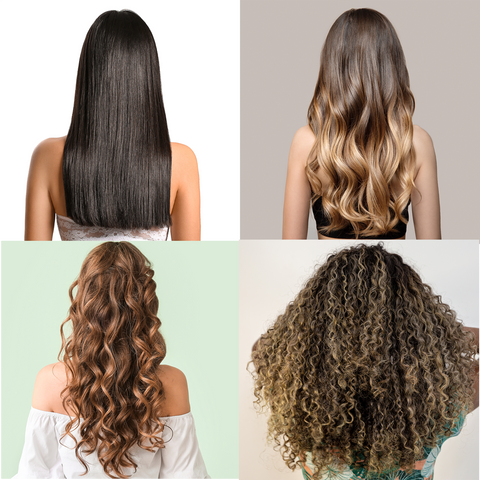
- Dries straight without a bend or curl: (type 1)
- Dries with a gentle “S” waves: (type 2)
- Dries with a defined curl: (type 3)
- Dries in tight coils or spirals: (type 4)
🍃 Care Tip: This air-dry test helps you see your hair’s natural pattern without interference from styling tools or residue.
A Note on Mixed Hair Patterns
Most people have more than one pattern — looser waves at the crown, tighter curls underneath. Even with the same curl pattern, texture, density, and porosity can vary widely.
📘 Learn More: Help Me Choose: Shampoo For My Hair
Hair Texture: The Thickness of Each Strand
Hair type explains your curl pattern, but texture describes how each strand feels and behaves.
Texture refers to the diameter of each strand — whether it’s fine, medium, or coarse. It determines how your hair responds to moisture, styling, and even weather.
Two people may both have Type 2 waves, yet one has baby fine strands that fall flat while the other has thick, resilient waves that hold shape for days. The difference is texture.
A Little Story from My Teen Years
When I was a teenager, my dear mom insisted my very fine, poker-straight hair needed to “look pretty” for a family wedding. At the salon, my hair was washed, rolled, and tucked under one of those old bonnet dryers. When the curlers came out, I’ll admit — it looked cute and bouncy.
But by the time we arrived at the evening wedding, not one curl remained.
At the time, I thought my hair was “stubborn.” Now I know it was simply behaving like fine, straight hair. Interestingly, now in my 70s, my gray hair has developed new body and wave — a reminder that hair texture can change through the years.
Fine Hair Characteristics
Fine hair is usually thin and delicate. Each strand typically has only two layers — the cortex and the cuticle — which makes it more fragile and prone to breakage.
Small-diameter strands mean that natural scalp oils travel quickly down the strand, making fine hair prone to looking oily or limp.
🍃 Care Tip: Fine hair is easily weighed down and needs lightweight cleansing and minimal conditioner to prevent limpness.
 Medium Hair Characteristics
Medium-textured is the most common. It usually has two layers, but some strands may contain a third inner layer called the medulla. It has more strength and volume, is easier to style, and is less prone to breakage.
🍃 Care Tip: Thrives on balanced hydration — enough moisture for flexibility without weighing strands down. It’s strong enough to handle moderate heat and styling yet supple enough to move naturally.
Coarse Hair Characteristics
Coarse hair has the widest diameter of all textures and usually has three layers: the cortex, cuticle, and medulla, which often gives hair a fuller appearance and more durability during styling.
Coarse hair can feel dry or rough to the touch, may become frizzy in humid weather, and takes longer to dry.
🍃 Care Tip: Coarse hair thrives with deep moisture. Rich, conditioning balms and nourishing oils help keep strands smooth, soft, and manageable.
In summary, your hair’s texture affects almost everything — from how easily it tangles and holds a curl to how well it absorbs moisture or product.
- Fine hair needs lightweight, balancing formulas that add body without weighing it down.
- Medium hair responds best to moderate hydration and flexible styling.
-
Coarse hair thrives on rich, deeply nourishing products that soften and smooth the cuticle.
Hair Texture vs. Density: A Common Confusion
People often describe their hair as “thick” or “thin,” but those words can refer to two completely different things — texture or density.
You can have fine hair that’s very dense (lots of thin strands packed closely together) or coarse hair that’s low in density (fewer thick strands spaced farther apart).
- Texture is the thickness of each strand.
- Density is how many strands grow on your scalp.
Think of it like a forest: texture is the size of each tree trunk, and density is how many trees grow in that forest.
Both influence how your hair behaves — but they do so in different ways. Together, they determine how full, heavy, or light your hair appears overall.
Hair Density: How Much Hair You Have
While hair texture describes the thickness of each strand, hair density refers to how much hair you actually have growing on your scalp. It is essentially the number of hair follicles per square inch.
How to Tell Your Hair Density
Some hair guides suggest using a simple mirror test to estimate density. While this can offer a rough idea, it’s not especially accurate. Because it relies on personal observation, it’s subjective — you often see what you expect to see.
Other factors, such as lighting, hair color, texture, or styling habits, can also skew results. And since density varies naturally across your scalp, one small area may not represent your overall density.
Still, if you’re curious, here’s how to try it:
- Stand in natural light with clean, dry hair and no product.
- Without parting your hair, look directly at your scalp.
- If your scalp is easy to see, you likely have low-density hair.
- If you can see some scalp but not much, your density is medium.
- If you can barely see your scalp at all, your hair is high-density.

The Three General Density Levels
Low Density
Low-density hair has fewer strands growing per square inch. Hair may appear fine or thin, and the scalp can be visible in some areas.
🍃 Care Tip: Benefits from lightweight, volumizing products that focus on adding body at the roots while keeping strands free of heavy oils or waxes.
Medium Density
Medium-density hair is the most common. The scalp is slightly visible in bright light, but the hair has noticeable body and fullness. Most products work well for medium-density hair as long as they match your texture and porosity.
🍃 Care Tip: Most products work well for medium-density hair as long as they match your texture. Lightweight formulas help prevent flatness and buildup. Don’t overload with products — aim for gentle nourishment that enhances your natural volume.
High Density
High-density hair has many strands packed closely together. It looks thick and voluminous, but can also feel heavy and be more prone to tangling. Because the product needs to reach every strand, moisture and slip are essential.
🍃 Care Tip: Focus on hydration and manageability. Richer conditioners, oils, and balms help detangle and maintain softness.
Texture and Density: How They Work Together
Texture and density often combine in interesting ways:
- Fine-textured, high-density hair — many delicate strands close together. Hair may look thick, but feel lightweight and fall flat easily.
- Coarse-textured, low-density hair — fewer, thicker strands that feel heavy and full but may reveal more scalp.
Together, these two characteristics determine how your hair behaves and how much product it needs. High-density hair requires more product to coat every strand evenly, while low-density hair can become greasy or weighed down if you use too much.
Hair Porosity: How Your Hair Absorbs and Retains Moisture
If hair type tells you about your curl pattern, texture describes strand thickness, and density reveals how much hair you have, then porosity is like your hair’s personality — it determines how it interacts with water and nourishment.
Porosity refers to how easily water, oils, and products pass in and out of the hair shaft. It depends on the condition of your cuticle layer — the outermost protective layer made up of overlapping, shingle-like cells.
When the cuticles lie completely flat and tight, moisture has a harder time entering (and leaving). When they are raised or damaged, moisture moves in easily — but can also escape just as fast.
Porosity isn’t about good or bad hair — it’s simply about how your cuticle behaves.
The Three Levels of Hair Porosity
High Porosity Hair
The cuticle layer is lifted, worn, or damaged — often from heat, chemical processing, sun exposure, or friction.
At first, high-porosity hair may seem easy to hydrate because it absorbs water and conditioner quickly.

But, due to gaps around the cuticle, that moisture escapes just as quickly. The result is hair that often feels dry, brittle, frizzy, and prone to breakage.
🍃 Care Tip: Focus on restoring and sealing moisture. Rich conditioners, leave-ins, and natural oils help smooth the cuticle and lock in hydration.
Medium (Normal) Porosity Hair
Medium-porosity hair has a cuticle layer that’s slightly raised, allowing a healthy balance between moisture absorption and retention. This hair type is usually shiny, bouncy, and manageable — not too oily, not too dry.
🍃 Care Tip: Maintain balance with gentle cleansing and moderate conditioning. Avoid excessive protein or heat, which can raise the cuticle and push hair toward higher porosity.
Low Porosity Hair
In low-porosity hair, the cuticle layer lies flat and compact, making it difficult for moisture or products to penetrate the strand. Moisture tends to sit on the surface, and product buildup can occur more easily.
🍃 Care Tip: Use gentle warmth and lighter oils to help moisture penetrate. Apply products sparingly to damp (not soaking wet) hair so they are more easily absorbed.
How to Tell Your Hair’s Porosity
The “Float Test” is popular online, but not very reliable. Too many variables — product buildup, water temperature, hair age, and mineral content — affect results.
Use it if you’re curious — but take online porosity test results with a grain of salt.
Why Hair Porosity Matters
Porosity influences how your hair responds to humidity, shampoo, conditioner, and styling products. If your hair can’t retain moisture, even the best ingredients will not have a chance to do their job.
Understanding your porosity, you can tailor your natural care routine:
- Low-porosity hair benefits from lighter, hydrating products and a bit of warmth to help moisture penetrate.
- High-porosity hair thrives on rich conditioners, leave-ins, and oils that help seal in moisture.
- Medium-porosity enjoys the best of both worlds — balanced care with no overloading.
Embracing Your Unique Hair
Your hair is a reflection of nature — and of you. Its type, texture, density, and porosity work together to create something beautifully individual. When you understand these characteristics, caring for your hair becomes less about control and more about partnership.
Two people can share the same curl pattern yet have completely different needs. Once you understand how your hair behaves, everything — from choosing the right shampoo bar to deciding how often to wash — becomes simpler and far more intuitive.
 At Chagrin Valley Soap & Salve, we believe that natural hair care begins with understanding — not forcing. Our products are made to work with your hair’s natural biology, not against it.
We never rely on synthetic silicones, artificial polymers, or “quick fixes.” Instead, we turn to the simplicity of nature — gentle botanicals, nourishing oils, and plant-based butters that strengthen, protect, and restore balance.
For us, it’s simple: when you harness the power of nature, you discover how effective hair and skin care can be. Nature already provides everything your hair needs to be strong, healthy, and radiant — our role is to bring those gifts together in their purest form.
No matter your hair type — straight, wavy, curly, or coily — the goal isn’t to change it. It’s to help it thrive as it was meant to be: vibrant, balanced, and naturally beautiful.
Because when you understand your hair — and trust in the wisdom of nature — you stop fighting it and start celebrating it.
🌿 Explore our collection of natural organic shampoo bars, conditioners, and herbal rinses crafted to harness the power and simplicity of nature.
Natural Hair Care Education Series
Explore related articles to learn more.
- Why Use A Natural Shampoo Bar?
- What Is Your Natural Hair Type?
- How To Use A Natural Shampoo Bar
- Natural Shampoo Bars: Questions and Answers
- Tips for a Smooth Shampoo Bar Transition
- Natural Remedies for Hair and Scalp Build-Up
- From Frizz to Fabulous: Dry Hair Causes, Care, and Management
- Make Your Own Natural Vinegar Hair Rinse
- How Does Your Water Affect Your Hair?
- Help Me Choose a Natural Shampoo Bar For My Hair Type Guide