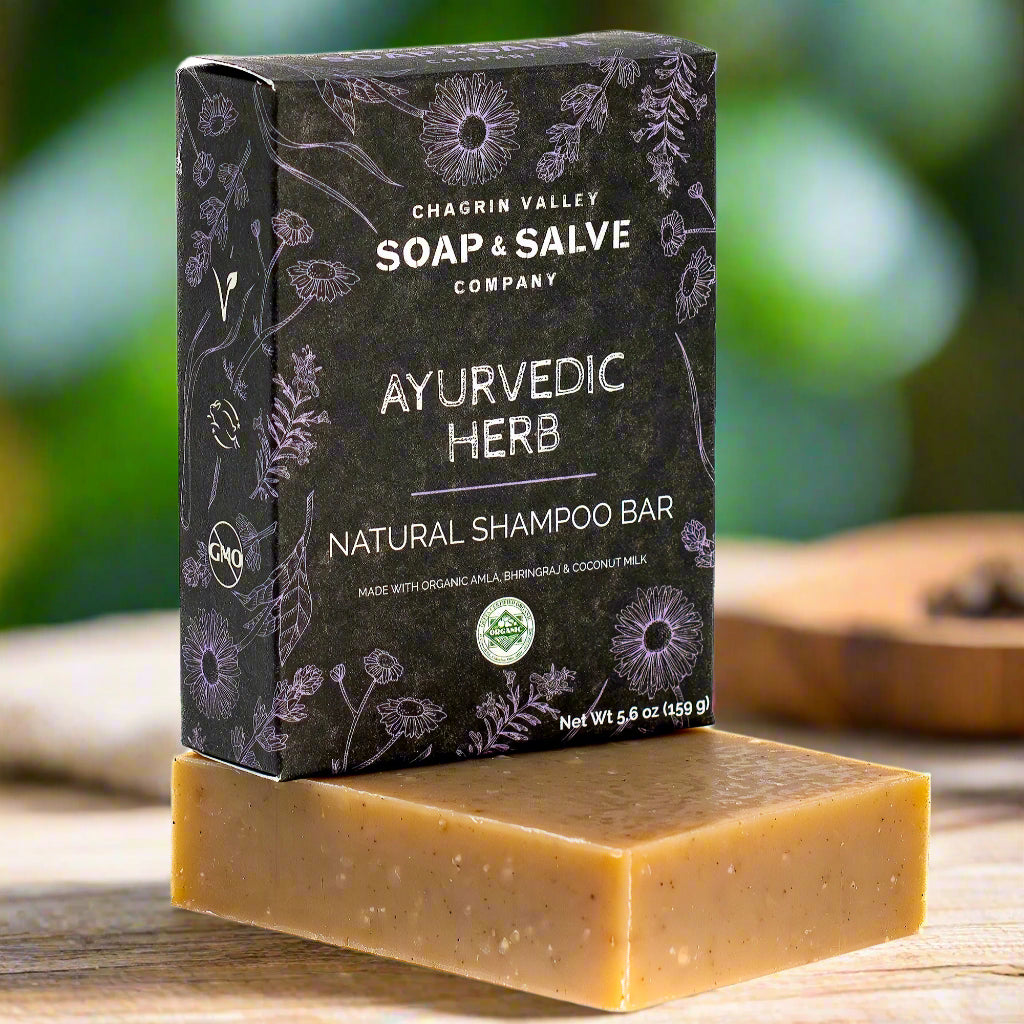
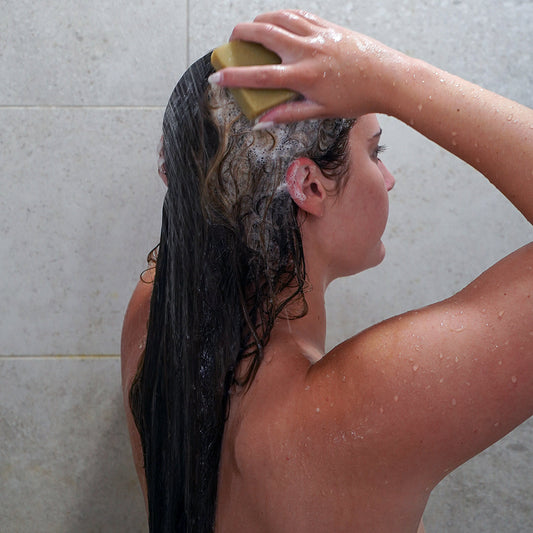
Why Use a Natural Shampoo Bar?
The Philosophy Behind Chagrin Valley Shampoo Bars
When I began making shampoo bars over twenty years ago, I had two goals: create the best natural shampoo I could — and do it in a way that respected our planet.
That commitment has not changed.
Over the years, shampoo bars have become increasingly popular. Some people are drawn to them for environmental reasons. Others are looking to simplify their routines or avoid certain ingredients found in liquid shampoos.
But not all shampoo bars are the same.
 If you are considering making the switch, it is important to understand what you are choosing — and why.
Not All Shampoo Bars Are Created Equal
There are two fundamentally different types of shampoo bars:
- Natural soap-based bars
- Detergent-based bars (often called “syndet” bars)
Soap-based bars are made through traditional saponification — a reaction between plant oils and an alkali that creates a natural surfactant called soap.
Syndet bars are made with synthetic detergents similar to those found in liquid shampoos.
These may include sulfate-based surfactants such as sodium lauryl sulfate (SLS) or sodium coco sulfate (SCS), as well as other synthetic detergents such as sodium cocoyl isethionate and sodium methyl cocoyl taurate.
In essence, they are concentrated liquid shampoos without the water or the plastic bottle.
If a bar claims to be “soap-free,” it is made with synthetic surfactants. That is not a judgment — it is simply chemistry.
That distinction matters because it represents two fundamentally different approaches to hair care — influencing not only how the bar cleans, but what it contains, how it is made, and what ultimately goes down your drain.
Ingredient Integrity in Natural Shampoo Bars
At its core, the difference between a soap-based shampoo bar and a detergent-based formula is a difference in ingredient philosophy.
Most liquid shampoos are primarily water — often up to 90%. Because they contain water, they require preservatives to prevent microbial growth.
Both liquid shampoos and solid detergent bars typically include synthetic surfactants (often sulfates), synthetic fragrance blends, thickeners, and stabilizers designed to enhance shelf life, texture, and scent.
Artificial colors like bright pinks, blues, or multicolored designs create beautiful bars that are visually appealing but far removed from traditional natural soap-making.
A solid soap-based shampoo bar is built differently.
Our natural shampoo bars contain no synthetic detergents, no sulfates, no artificial fragrances, no synthetic colors, and no preservatives.
Instead, they are made with certified organic plant oils and butters, botanical infusions, natural clays and plant-based colorants, and pure essential oils chosen for function — not flash.
This simplicity is intentional.
It is not about fear. It is about transparency, clarity, and thoughtful formulation.
Lather and Bubbles — But Built Differently
Ingredient philosophy shapes formulation — but it also shapes how a shampoo actually works.
If you want to create a product that cleans and lathers, you need a surfactant.
If not a natural surfactant, like soap, then a synthetic detergent or syndet.

Surfactants are ingredients that bridge the gap between water and greasy dirt, allowing them to bind together and be easily washed away.
Syndet shampoo bars use the same types of synthetic detergent surfactants found in liquid shampoos — simply in solid form.
Because the cleansing system is essentially the same, the washing experience often feels very similar.
It makes sense that if your hair and scalp have adapted to the ingredients in a bottled detergent shampoo, your transition to a syndet bar may be easier.
A natural shampoo bar is built on a different system.
Instead of synthetic detergents, it is made through the saponification of plant oils. Those oils are not just carriers of fragrance or texture; they become the cleansing agent itself.
Because the cleansing system itself is different, the experience is different.
It influences how the bar interacts with your scalp’s natural oils, how it behaves in water, what additional ingredients are needed in the formula, and what ultimately flows back into the environment.
A natural shampoo bar is not just a solid version of liquid shampoo — it is a fundamentally different approach to cleansing.
👉 Learn More: How Do Natural Soap & Shampoo Bars Create Lather?
Crafting a Natural Shampoo Bar with Intention
A shampoo bar is not simply a bar of soap relabeled for hair — it is designed specifically for the needs of hair and scalp. And it is only as thoughtful as the formulation behind it.
Commercial products are often designed for mass production and cost efficiency. Ingredient selection frequently begins with price and scalability.
A true natural shampoo bar requires a different mindset.
Our recipes are formulated in-house, in small batches, with intentional blends of plant oils chosen for scalp compatibility, lather quality, and overall hair feel.
 Herbs, clays, milks, and essential oils are not decorative additions — they are selected to complement the oil blend and serve a specific purpose. Each bar is crafted with a specific hair type or need in mind.
This is not about novelty.
It is about thoughtful formulation — building a bar from the ground up with whole ingredients that work together.
Environmental Responsibility Is Not an Afterthought
Yes — shampoo bars eliminate plastic bottles.
In the United States alone, hundreds of millions of shampoo bottles are discarded every year. Recycling rates remain low, and plastic can persist in landfills and oceans for centuries, breaking down into microplastics that move through water, soil, wildlife, and even our own bodies.
Choosing a solid natural shampoo bar reduces that waste at the source.
But environmental impact goes beyond packaging.
When shampoos filled with synthetic detergents, preservatives, and artificial fragrances wash down our drains, those compounds enter wastewater systems and eventually make their way into rivers, lakes, and oceans. Research continues to examine the long-term ecological impact of many personal care ingredients on aquatic life and water quality.
Our commitment extends beyond what we avoid.
Our natural shampoo bars are made with certified organic ingredients. Organic farming practices protect soil health, reduce synthetic pesticide and fertilizer use, and help safeguard groundwater from contamination. They promote biodiversity, responsible land stewardship, and the conservation of soil and water resources.
Ingredient choice matters — not just for your scalp, but for the agricultural systems that produce those ingredients.
From sourcing to packaging to what flows back into the earth, our shampoo bars are designed with the full life cycle in mind.
Environmental stewardship is not a marketing trend for us. It is part of how we make decisions.
The Truth About Marketing Language
As interest in cleaner personal care grows, more and more companies are trying to figure out ways to make their products seem "more natural."
“Sulfate-free” does not necessarily mean detergent-free.
“Plant-derived” does not mean natural.
“Fragrance” may represent a blend of undisclosed chemicals.
Attractive packaging and carefully chosen "natural" marketing language are designed to attract attention. Even some "natural" shampoo bars contain synthetic fragrance. Ingredient lists tell the truth.
If you want to understand what you are putting on your scalp — and what you are rinsing into the environment — look past the front label and read the ingredient panel.
Education empowers. Advertising persuades.
Practical Benefits That Simply Make Sense
A natural solid shampoo bar is a concentrated product.
Zero-Waste & Plastic Free: Packaged in recyclable paperboard boxes, they eliminate plastic bottles, reducing landfill waste
Cost-Effective: Because it contains little water, you are not paying for a diluted formula. One properly cured bar can often replace two to three bottles of liquid shampoo and may last for 50–90 washes, depending on hair length and usage.
Travel Friendly & TSA Approved: Its solid form makes it compact, lightweight, and easy to take anywhere. There are no spills, no plastic bottles, and no need to transfer liquids into smaller containers. As a non-liquid product, it is TSA-friendly and ideal for carry-on travel.
Double Duty: Shampoo bars are also incredibly versatile. A well-formulated bar can double as body soap and even shaving soap, making it a practical choice for camping, business trips, the gym, or simplified everyday routines.
Carbon Footprint: The reduced size and weight mean less energy is required for transportation compared to shipping heavy bottles filled primarily with water. Over time, that smaller footprint adds up.
Biodegradable: And because natural soap is biodegradable, it breaks down more readily in the environment, reducing the long-term impact of what flows down the drain.
These are practical advantages of a solid, water-free design — thoughtful benefits that complement a more intentional approach to personal care.
Making A Thoughtful Choice
So how do you know if a natural shampoo bar is the right choice for you?
 If you are choosing a shampoo for yourself and your family, do you prefer a short list of simple, organic ingredients?
When it comes to scent, do you feel more comfortable with pure essential oils than synthetic fragrance blends?
If you could choose a product that puts fewer synthetic materials into our ecosystems, would you?
In selecting a company, do you value small-batch craftsmanship over mass production?
Do cruelty-free standards, responsible sourcing, and sustainable packaging matter to you — not as marketing claims, but as part of your everyday decisions?
And if you understand that there may be a brief adjustment period when transitioning from detergent-based products to a natural cleansing system, are you willing to allow your hair time to rebalance?
Switching to a natural shampoo bar is not simply a change in format. It is a shift in philosophy — from engineered convenience to ingredient intention, from uniform performance to working in partnership with your hair and environment.
That shift is not for everyone. It requires a bit of curiosity, a bit of patience, and a willingness to read beyond the front label.
There is no universal “right” choice.
When those questions matter, the choice becomes more than convenience — it becomes intention.
Natural Hair Care Education Series
Explore related articles to learn more.
- Why Use a Natural Shampoo Bar
- What Is Your Natural Hair Type?
- How To Use A Natural Shampoo Bar
- Natural Shampoo Bars: Nature-Driven Hair Care Explained
- Natural Shampoo Bars: Questions and Answers
- Tips for a Smooth Shampoo Bar Transition
- Syndet vs. Natural Shampoo Bars: Understanding the Difference
- Natural Remedies for Hair and Scalp Build-Up
- From Frizz to Fabulous: Dry Hair Causes, Care, and Management
- Make Your Own Natural Vinegar Hair Rinse
- How Does Your Water Affect Your Hair?
- Help Me Choose a Natural Shampoo Bar For My Hair Type Guide
This blog, originally published in 2016, has been updated with new content.