
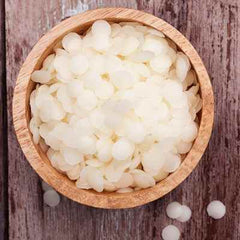
Soy Wax
Skin-Safe, Moisture for Body Lotion Candles
Soy wax, hydrogenated Glycine soja (soybean) oil, melts at approximately 100°F—just slightly warmer than body temperature—making it an ideal ingredient for body lotion candles and massage candles. When melted, it becomes a warm, silky emollient that glides over the skin and absorbs gently, leaving the skin soft, moisturized, and lightly conditioned.
Our vegan soy wax is made from 100% pure soybean oil and is FDA-regulated for food use, ensuring purity and quality. As a natural moisturizer rich in vitamin E and antioxidant compounds, soy wax helps soften, soothe, and protect the skin. Its creamy texture forms a breathable, protective barrier that helps lock in moisture, making it a soothing option for dry, cracked, or irritated skin.

Benefits of Soy Wax for Skin
- Moisturizes by sealing in hydration and softening dry areas
- Forms a protective barrier to help reduce moisture loss
- Rich in antioxidants, including vitamin E
- Soothes sensitive or irritated skin, and may help comfort eczema- or psoriasis-prone areas
- Non-comedogenic, meaning it won’t clog pores
Why We Use Soy Wax
We introduced soy wax after receiving many requests for a vegan alternative to our original body candle formulation. Soy wax is the only vegetable wax that naturally melts at the perfect skin-safe temperature for a warming lotion candle—no other plant-based wax performs the same way.
Quick Note About Hydrogenated Oils in Skincare
Some people worry about hydrogenated oils in skincare because eating trans fats is unhealthy. But the body handles them very differently on the skin than in the digestive system.
When you eat hydrogenated oils, your digestive system breaks them down into trans fats, which can enter the bloodstream.
When you apply hydrogenated oils to your skin, your skin cannot break them down in the same way. They simply stay on the surface, forming a moisturizing layer that softens and protects dry skin. They do not enter the bloodstream or behave like dietary trans fats.
Bottom line: hydrogenated oils in skincare do not carry the same health risks as eating trans fats—they remain on the skin’s surface and are used only for their moisturizing benefits.
Special Notes: Buyer Beware
“Organic” Soy Wax?
Be cautious of companies claiming to use organic soy wax. There is no such thing as USDA Certified Organic soy wax.
All vegetable waxes—including soy—are made by hydrogenating liquid oil so it becomes solid.
Since USDA Organic standards have been developed for the food industry, waxes made from hydrogenated liquid oil cannot meet "Organic" Certification standards. If a company makes the organic soy wax claim, ask to see the organic certificate!! They will not be able to provide one.
“Non-GMO” Soy Wax?
We would buy certified non-GMO soy wax if it were available, but true non-GMO wax is extremely rare. More than 90% of U.S. soybeans are genetically modified, and the small amount of non-GMO soy that does exist is typically reserved for food, not for use in wax.
Our wax supplier tests every batch to ensure the finished wax contains:
- No detectable genetically modified material
- No pesticides
- No herbicides
Why this matters
In a genetically modified organism (GMO), the DNA is altered, and that DNA is located in the protein part of the soybean.
During the extraction and refining process for creating vegetable oils such as soybean, the modified proteins are removed. However, since DNA molecules are tiny, trace amounts may still remain.
That’s why the wax is tested for genetically modified material: it confirms there is no detectable modified DNA in the final product.
However, this does not mean the original soybeans were non-GMO. It only tells us that the finished wax is free of genetically modified DNA.
Some companies claim their wax is “non-GMO” simply because the GMO markers don’t transfer into the oil used to make wax. This is marketing language—not a reflection of how soybeans are grown.
The more transparent approach—and the one we follow—is to rely on testing the finished wax to confirm purity, regardless of the soybean’s origin.
Bottom Line: Soy wax is made from oil, not protein, so GMO DNA is not present in the finished wax. Testing the final wax is far more meaningful than claiming “non-GMO soybean wax".
Important Note for Customers Who Prefer Non-GMO Crops
If you avoid GMOs for agricultural, environmental, or ethical reasons, it’s important to know that soy wax—no matter how pure or well-tested—does not guarantee that the original soybeans were non-GMO.
While the final wax contains no detectable GMO material, it does not fully meet the needs of customers who choose products made exclusively from non-GMO crops.


