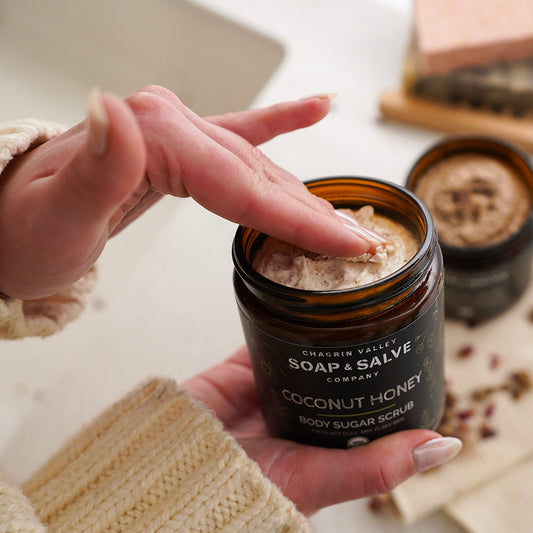
Body Scrub: Mocha Java Body Sugar Scrub
- Out Of Stock
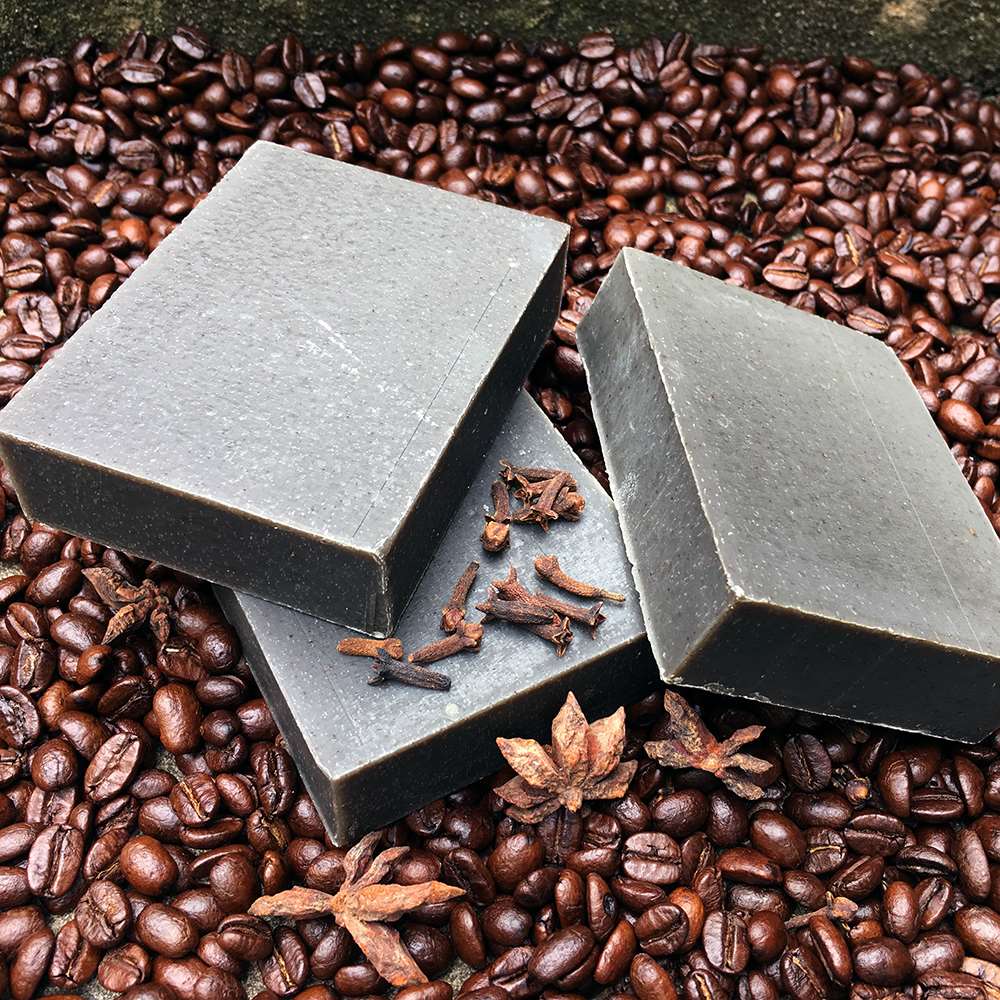
A boldly exfoliating soap made with real coffee grounds, bamboo charcoal, and a warm, spicy essential oil blend. Enriched with shea and cocoa butters, this scrubby bar delivers a deep, satisfying clean with a rich lather — ideal for hands that work hard and skin that enjoys a little grit.
Good For: Exfoliation • Normal to Oily Skin
Coffee & Clove was originally created as a hardworking hand soap — and it still shines there — but many people quickly discovered it’s just as satisfying in the shower. This is not a delicate bar. It’s bold, scrubby, and unapologetically effective.
The lather is rich and creamy, carrying freshly ground coffee, charcoal, and botanicals across the skin with a noticeable grit. As you wash, the exfoliation feels purposeful and invigorating — especially welcome after gardening, cooking, or working with your hands.
The blend of coffee, charcoal, and essential oils helps lift away lingering kitchen and workshop odors, leaving hands feeling clean and refreshed, with richness from the butters keeping the experience balanced.
The aroma is warm and unmistakable. Freshly brewed coffee anchors the scent, while clove and anise add spicy depth and comfort. It’s the kind of fragrance that feels grounding and familiar — like a well-worn workspace or a favorite mug in the morning.
This is a soap for people who like their cleanser to do something. Strong, practical, and deeply satisfying, it earns its place by the sink, in the shower, or wherever hard work happens.
Note: Because of its scrubby texture and bold essential oil blend, this soap is not recommended for sensitive or easily irritated skin.
Every ingredient in this soap is chosen for a reason. Thoughtfully combined, they work together to create something richer than a simple cleanse — a carefully crafted bar that goes beyond ordinary soap.
Highlights of this recipe:
👉 Learn more about our Aroma, Texture & Lather notes
Bold scrub. Warm spice. Built for hands that work hard.
The purpose of soap is to combine with oil and dirt on the body, which allows water to wash it away. The method you use to cleanse your skin is really a personal preference. We thought we would share just a few examples.
Bar Bathers rub the bar directly on their skin to create a creamy lather. Massaging the velvety lather into your skin before rinsing allows you to experience the best moisturizing properties of the soap. This is definitely the best way to use exfoliating soaps.
Hand Latherers create lather in their clean hands and use the lather to massage and wash the skin. This gentle, mild cleansing method may be good for those with sensitive skin.
Washcloth Washers use a washcloth to lather up. Washcloths are made out of lots of different textile textures, from soft cotton to agave fibers, and can provide very gentle to intense exfoliation. Be sure washcloths are laundered and dried often.
Puff Polishers use a mesh puff that works up a foamy, bubbly lather, even with hard water, to wash and gently exfoliate the skin. Poofs make natural soap last longer but can harbor bacteria, so rinse thoroughly after use and replace every few weeks or clean per manufacturer's instructions.
Loofah Latherers love their loofahs that exfoliate and help increase circulation. Whole loofahs can be breeding grounds for bacteria, so be sure they dry out properly after use and replace them every two months. If you would like something less abrasive, check out our Bath & Body Accessories.
Soap Sackers place their soap into a nylon soap bag. The fibers have a smooth texture for gentle cleansing. Soap sacks can be used for whole bars of soap or scraps that would normally be thrown away.
There is a large variety of bathing accessories available. If using any accessory, never share them with others and replace or clean them often.

The goal is simple: to Harness the Power & Simplicity of Nature® to cleanse, soothe, heal, and protect your skin and hair!
Our unique formulas rely on moisturizing oils and butters, healing botanicals, and pure essential oils. We choose every ingredient with one end-result in mind….the BEST possible natural skin care for YOU!
Organic Coffee Beans*
Bamboo Charcoal
Organic Anise Essential Oil
Contains both brewed coffee and ground coffee
|
*Ingredient is Fair Trade Certified ^Used in the saponification process to turn oil into soap and glycerin. None remains in the finished product.
|

Regular handwashing is one of the best ways to remove germs, avoid getting sick, and prevent the spread of germs to others.
The CDC (Centers for Disease Control and Prevention) says that for good hand hygiene all you need is plain soap and water.
Clean hands can stop germs from spreading from one person to another and throughout an entire community.
Five simple and effective steps can help reduce the spread of illness so you, your family, your friends and the general public can stay healthy.
CDC recommends cleaning hands in a specific way to avoid getting sick and spreading germs to others. The guidance for effective hand washing was developed based on data from a number of studies.
1. Wet your hands with clean, warm running water and apply soap.
2. Lather your hands by rubbing them together with the soap.
3. Scrub your hands for at least 20 seconds.
4. Rinse your hands well under clean, running water.
5. Dry your hands using a clean towel or air dry them.
To date, studies have shown that there is no added health benefit for consumers (this does not include professionals in the healthcare setting) using soaps containing antibacterial ingredients compared with using plain soap.
Information is taken from the CDC.gov website
Read our blog "Simple Soap Can Help Decrease the Spread Of Viruses"
Saying a soap is "handmade" says nothing about quality of the ingredients or the knowledge and skill of the soapmaker!
Chagrin Valley is not just another soap and skincare company. We are committed to healthy skin, healthy people and a healthy planet.
We are a USDA Certified Organic Company specializing in luxurious, organic, handmade natural soaps and shampoo bars rich in natural glycerin for healthier skin and hair.
It's all about the ingredients! Inspired by our love of nature, we use organic herbs, seeds, flowers, vegetables, fragrant spices, fruits, pure essential oils and purifying clays for their exceptional skincare benefits and to provide natural color, aromatherapy, texture, or gentle exfoliation. Nothing artificial, nothing synthetic, no GMO’s, just natural wholesome ingredients.
Our soap making process uses only natural and organic ingredients. Why add artificial ingredients to a handmade product?

"Are All Handmade Soaps The Same?"
"12 Reasons to Use Natural Soap"
NO! Adding antibacterial chemicals to soap does not keep your family safe from germs.
I understand why folks (especially those with children) are choosing products labeled “Antibacterial,” hoping to keep their family safe in the war against germs.
According to Janet Woodcock, M.D., director of the FDA’s Center for Drug Evaluation and Research (CDER).
"Consumers may think antibacterial washes are more effective at preventing the spread of germs, but we have no scientific evidence that they are any better than plain soap and water.
In fact, some data suggests that antibacterial ingredients may do more harm than good over the long-term.”
Simply washing your hands with old-fashioned natural soap and water rids your skin of most fungi, bacteria, and viruses. Soap does not kill germs, it surrounds them and carries them away.
Please read our blog: Antibacterials: More Harm Than Good!
USDA Organic Certification was created for food production (not the personal care industry) and as a result is based on organic farming and agriculture standards.
The list of allowable non-agricultural ingredients (like clay, salts, mud, etc) is based on raw materials used in farming. Agricultural ingredients have a biological origin and are made up of carbon. Non-agricultural ingredients have a non-biological origin.
For example, ingredients that come from plants and animals are agricultural, whereas salts, clays, baking soda, pumice, and water are non-agricultural.
Since clays like kaolin and bentonite have farming/agricultural uses, they appear on the list. Unfortunately, ingredients like Pumice, Dead Sea Mud, and Bamboo Charcoal are not used in farming or food production and thus do not appear on the list. Sometimes an ingredient, such as Magnesium Hydroxide, appears on the list but can only be under certain circumstances. Magesium hydroxide can only be used as a nutrient supplement for animals.
Products that contain these ingredients like our Sensitive Skin Deodorants, Clay Facial Masks, and Bamboo Charcoal, Loofah Pumice Foot, and Dead Sea Mud soaps, as well as our Mud & Clay and Rosemary Mint Charcoal Shampoo Bars cannot display any organic symbol or even state that they are organic.
Since we are a certified organic company, we must follow the rules of the USDA. Even though these products are made with certified organic ingredients that meet the same rigorous standards as those required for our "Organic" products, we cannot call them "organic." Sadly if you are not a USDA Certified Organic company, you can do whatever you want :-(
For more detailed information, please read our blog, "What Do All of the Organic Labels Mean?"
We sometimes receive emails that go like this:
The good news is that when you purchase natural soap from an organic skincare company, it is scented with only pure essential oils.
The bad news is that when you purchase natural soap from an organic skincare company, it is scented with only pure essential oil.
The scent of an essential in any totally natural product can and will change over time and from batch to batch.
Essential oils come from nature. The quality and scent of essential oils are affected by yearly weather conditions and varies from crop to crop and region to region.
This makes it very difficult to produce finished products in which the scents are always exactly the same.
Most commercial soaps (and skincare products), even some of the "natural" ones that contain some essential oils, are made with at least some synthetic fragrances oils, nature identical oil, or natural fragrance oil. Using any synthetic fragrance ensures a more consistent scent.
Essential oils are temperamental to work under any circumstance. But while a natural essential oil scent blend may change a bit in a cream or oil, these blends are especially unpredictable when making cold processed natural soap.
After all my years of soap making in never ceases to amaze me just how much the actual soap making process changes the scent of an essential oil blend.

Natural Soap and Essential Oils
Why We Use Only Real Plant Essential Oils?
Natural Fragrance Oil? . . . Really?
Why Are Synthetic Fragrance Oils So Popular?
The "certified organic" labeling has been developed by the USDA and refers to organic claims and labeling on food and personal care products in the United States. The USDA has very strict guidelines for the percentage of organic ingredients necessary to receive organic certification. Other countries have their own certification procedures, requirements, and standards. Labeling criteria and allowable ingredients differ from those in the US.
The USDA Organic Logo Label can be used on products that meet the standards of the first two tiers of the organic labeling system in which 95 - 100% of the ingredients are certified organic.
Most of our non-soap products fall into this category and display the USDA logo!
The Certified Organic by OEFFA label is used in our company for two reasons . . .
Soaps and Shampoos: These products contain at least 8% of the sodium hydroxide due to the process of soapmaking. Our "organic" soap is about 87% to 92% organic, but the USDA standard states that a product must be made of 95-100% organic ingredients in order to bear the USDA Certified Organic seal shown above. We are also not allowed to use the words "organic soap" on the label.
Wildharvested Ingredients: When using any agricultural ingredient (any ingredient that has a biological origin) that is not certified organic the same labeling rules we use for soap apply.
The USDA rules for proper labeling state that the products may display the certifying agent's logo but not the USDA organic logo. Our USDA certifying agency is OEFFA (The Ohio Ecological Food and Farm Association). Their logo is displayed on our "organic" soaps and shampoos.
Why do some soap companies use the word "organic" on their labels--even though it is against the rules? Click Here to Read More about Rules for Organic Labeling of Soap!
We sometimes use an unofficial symbol for products made with "natural" ingredients that do not meet the criteria for either label above. You may see this type of symbol on products, like the Dead Sea Black Clay, Bamboo Charcoal, and Loofah Pumice Foot Soaps and our Mud & Clay and Rosemary Mint Charcoal Shampoo Bars.
Organic certification is based on organic farming and agriculture standards. As a result, the list of allowable non-agricultural ingredients (like clay, salt, mud etc) is based on raw materials used in agriculture or food production. Unfortunately, ingredients like some Clays, Pumice, Dead Sea Mud and Bamboo Charcoal are not used in farming or food production and thus do not appear on the list.
Although it may seem long, this is really a very brief description. For more detailed information please read, "What Do All Of The Organic Labels Mean?"
Yes, they are!
Chagrin Valley natural soap and shampoo bars are made with natural and organic ingredients and are biodegradable when used properly.
They’re thoughtfully crafted to break down naturally in the environment, which makes them a responsible choice for everyday use and for outdoor adventures when used with care.
By definition, biodegradable means capable of being broken down by living organisms, such as naturally occurring bacteria, into simpler substances that are not harmful to the environment.
Natural soap made with plant oils, butters, and clays can biodegrade efficiently — but where and how it’s used matters.
Bringing a biodegradable soap on a camping or backpacking trip is a wonderful way to stay comfortable and refreshed outdoors. However, even biodegradable soap should never be used directly in lakes, rivers, or streams.

You may see claims online suggesting that biodegradable soap or shampoo is safe to use directly in rivers and streams.
While these claims are often made with good intentions, they overlook an important part of how biodegradation actually works.
The bacteria responsible for breaking down natural soap live primarily in soil, not water.
That means soap — even biodegradable soap — breaks down most effectively when it comes into contact with organic soil, not freshwater sources.
Even biodegradable soap will pollute lakes and streams if it is not used properly.
So while our soaps are biodegradable, they are designed for mindful outdoor use, not for bathing, washing dishes, or cleansing directly in natural water sources.
A few simple practices help protect waterways and support natural breakdown:
These methods help surround the soap with organic matter, speed up decomposition, and reduce runoff.
Yes — when used responsibly.
Many commercial soaps, body washes, shampoos, and dish detergents contain synthetic surfactants, artificial fragrances and colors, and chemical preservatives.
Since these ingredients do not break down quickly, traces can persist in the environment for many, many years and can have a potential negative impact on plants and animals.
A biodegradable natural soap made with plant-based ingredients breaks down more readily when exposed to soil bacteria, making it a far better choice for outdoor use — as long as it’s used thoughtfully and away from waterways.
Biodegradable doesn’t mean anywhere.
It means used with intention and respect for nature.
That philosophy is at the heart of how we make our soaps — and how we encourage them to be used.
There’s no substitute for nature. Together, we can protect it from impacts like overuse, trash, and harming endangered wildlife by following the principles of "Leave No Trace."
Yes And No!
Although handmade natural soaps usually get better with age, we recommend using our soaps within 12 months of purchase. Our scented soaps should be used within 3 months after removing them from the box.
Although the soaps will not be "spoiled" after that time, you may notice some changes as natural soap ages.
The changes in color and scent happen even more quickly in our sample size bars.
These small natural soap bars have a much greater surface area to volume ratio which allows essential oils to evaporate from the surface more quickly. However, the scent may still be there when you lather up.
I have found some ancient bars hiding in my closet that years old. The scents were gone, but the lather was incredible!
For a more detailed discussion please read our blog, "The Shelf Life, Color & Scent of an All Natural Soap."
Sustainable, activated bamboo charcoal has become a key ingredient in many skincare products due to its natural ability to draw out dirt and debris from deep inside pores,
Read Post
Get informed about exfoliation! Explore the basics, benefits, and best practices for exfoliating your skin so you can make informed decisions about your skincare. Exfoliation can help encourage cell turnover, unclog pores, allow moisturizers to penetrate more effectively, and refresh the skin.
Read Post
Help Me Choose a Natural Soap: Your skin type is unique to you! We have compiled natural soap recommendations based on information gathered from friends, family, and customers. We hope this will help you make your choices based on skin care needs and sensitivities.
Read Post